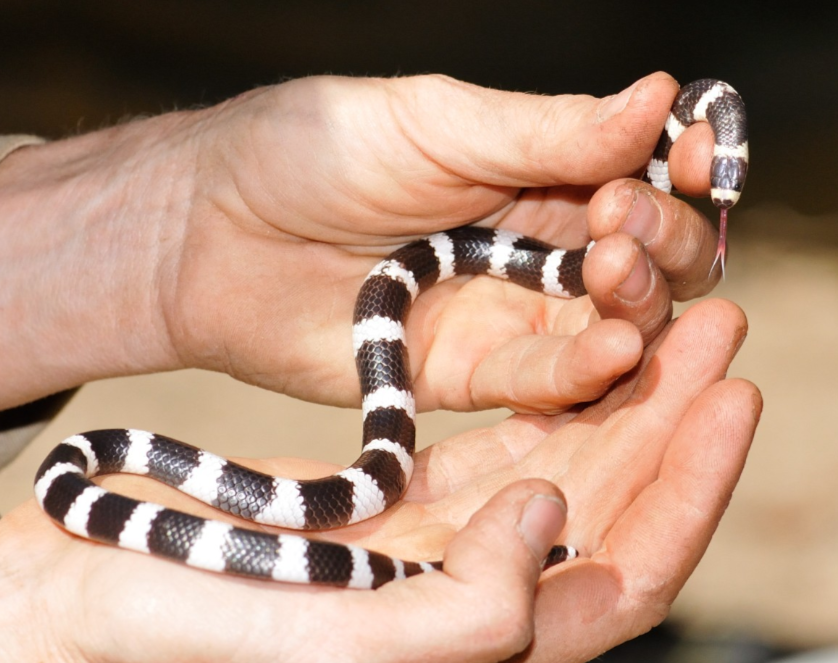
Eastern Bandy-bandy Snake
Vermicella annulata
Eastern Bandy-bandy Snake
The Eastern Bandy-bandy Snake (Vermicella annulata), is one of 6 known species of bandy-bandy (bandi-bandi) endemic to Australia, from the venomous snake family Elapidae. The Eastern Bandy-bandy snake is particularly striking as a result of their distinctive black and white banding pattern.
They are one of Australia’s smallest snakes, growing to approximately 60cm, with the females tending to be larger than the males.
Eastern Bandy-bandy Snakes are fossorial, adapted to burrowing and living primarily but not solely underground.
A nocturnal species they feed almost exclusively on Blind Snakes, and hunt using chemical cues collected through tongue flicking. As the Blind Snake is a larger species than the Eastern Bandy-bandy by comparison, sometimes part of the prey is still sticking out of the Bandy-bandy’s jaws as it is slowly digesting the first part of the snake! Because they eat such large prey the Bandy-bandy has a very low feeding rate.
The Bandy-bandy has a unique defensive display; it bends it’s body into multiple loops raised off the ground, then with tail and head at ground level it moves it’s tail closest to the predator, and head protected under the loops. This is an intimidating move for predators at ground level. See the video (thanks to terrific footage by @Jesse’s Wildlife).
Elapids carry dangerous neurotoxins in their venom that can be notoriously deadly to humans. Unlike most of the Elapidae family members the Eastern Bandy-bandy is weakly venomous with localised symptoms around the bite area. It is generally considered harmless due to the small size of its mouth and its inoffensive nature.