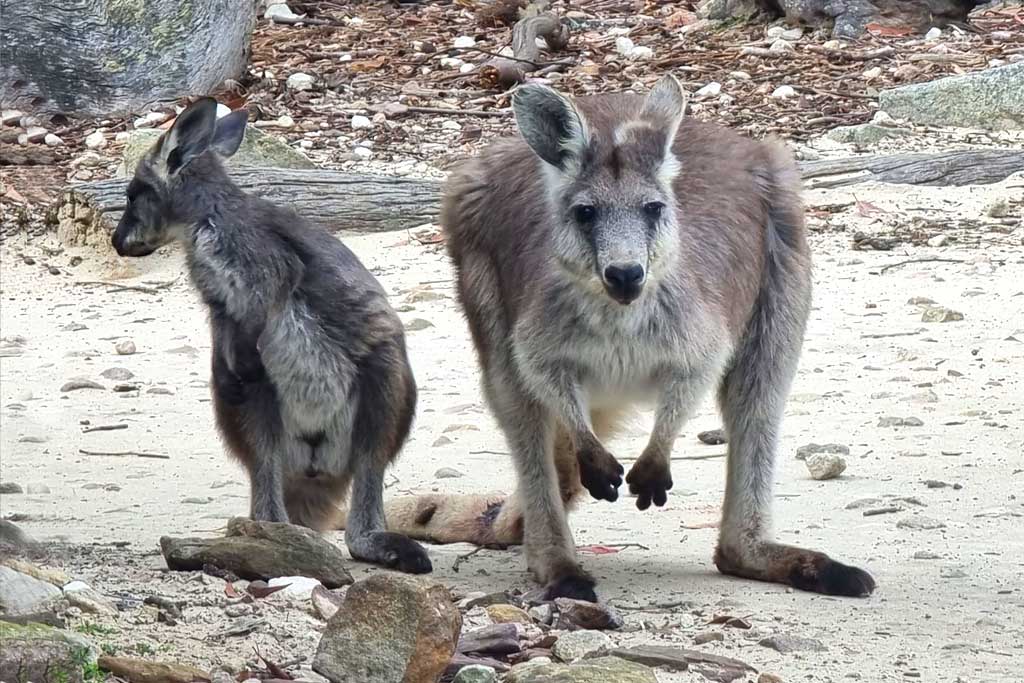
Wallaroo
Other common names for this macropod are Common Wallaroo, Hill Wallaroo and the Euro.
Wallaroos ~ Macropus robustus
Wallaroos are found across most of Australia.
Although physically more like kangaroos, wallaroos’ genetic make-up is closer to that of some wallabies and can cross-breed with some wallaby species. Despite this sharing of traits with kangaroos and wallabies, the wallaroo is not a hybrid kangaroo-wallaby cross, althought it probably appeared that way to the person who first named it a “wallaroo”.
Wallaroos are found in many different kinds of habitat. They like steep rocky places with lots of shelter from Australia’s extreme temperatures. They also like to shelter in thick bush near billabongs. Their diet is mainly grasses and shrubs.
At Walkabout Park you will meet a very special wallaroo family. Our first wallaroo was rescued from the pouch when her mother was killed by a hunter. A female wallaroo, she was raised carefully paying attention to maintaining her natural wallaroo behaviours and discouraging her from expecting food from people. She was, therefore, placid and relaxed around people.
Wallaroos are large strong animals. The males are more inclined to show aggressive traits. Because of their size and behaviour, it is not considered safe for hand-raised male wallaroos to interact with people. All of our male wallaroos were mother-raised to ensure that they don’t want to approach people. Because at Walkabout Park visitors go into the animal’s world where the wildlife is free to roam through the sanctuary, it is particularly important that Walkabout Park does not have any hand-raised male wallaroos.